SINPAIN at MEDICON 2026: Advancing AI-assisted assessment of knee osteoarthritis
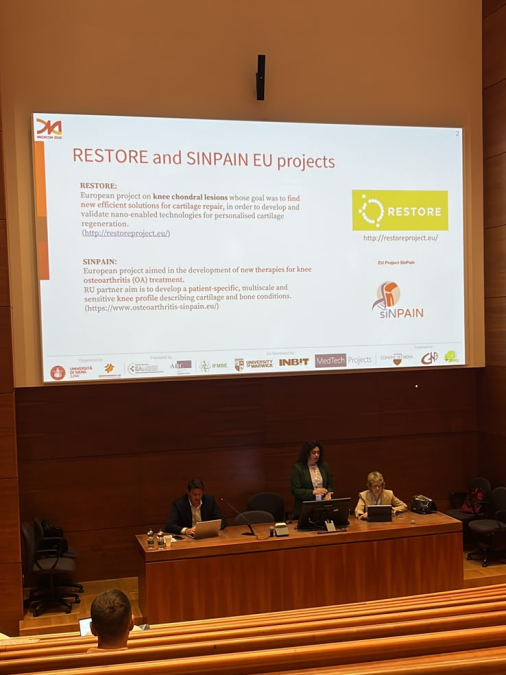
SINPAIN research was presented at MEDICON 2026 in Siena, Italy on 14-17 September 2026! Ida Maruotto from the Institute of Biomedical and Neural Engineering at Reykjavik University presented their research results exploring how medical imaging and artificial intelligence can contribute to a more comprehensive and clinically useful assessment of knee osteoarthritis.
Within SINPAIN, the team at Reykjavik University combines biomedical engineering, medical imaging and machine learning to extract quantitative information from knee scans and improve the assessment of osteoarthritis. Previous SINPAIN research from the team has investigated imaging features of cartilage as well as changes in bone, muscle and intramuscular adipose tissue, reflecting the understanding of osteoarthritis as a complex disease involving different tissues of the joint. Their work also explores how artificial intelligence can help turn this imaging information into objective tools for OA classification and assessment.
At MEDICON 2026, Ida Maruotto presented two research works building on this expertise:
Knee Osteoarthritis as a Multi-Tissue Disease
The first study, “Knee Osteoarthritis as a Multi-Tissue Disease: Multivariate Analysis of Cartilage, Bone, and Muscle on CT Imaging”, investigates relationships between cartilage, bone and muscle. By analysing these tissues together rather than focusing on cartilage alone, the research explores how their interactions can contribute to improved detection and characterisation of knee osteoarthritis.
Explainable AI with clinical application in mind
The second study, “Probabilistic SVM for Knee Osteoarthritis Classification”, focuses on an explainable artificial intelligence approach for OA classification in the clinical context. Based on cartilage conditions, the method provides a probabilistic range for the classification of osteoarthritis. At the same time, it offers clinicians a geometrical interpretation of how the model reaches its classification.
Both contributions continue Reykjavik University’s work within SINPAIN at the intersection of medical imaging, quantitative analysis and machine learning. MEDICON 2026 provided a valuable opportunity to share these latest results, exchange ideas and connect with researchers working on medical imaging, osteoarthritis and artificial intelligence.